
Fundamentals of Artificial Intelligence
Artificial Intelligence (AI) is a branch of computer science that aims to create machines that mimic human intelligence. AI-Powered Drone Technology is an application of AI in drones to enable them to perform tasks autonomously and intellig…
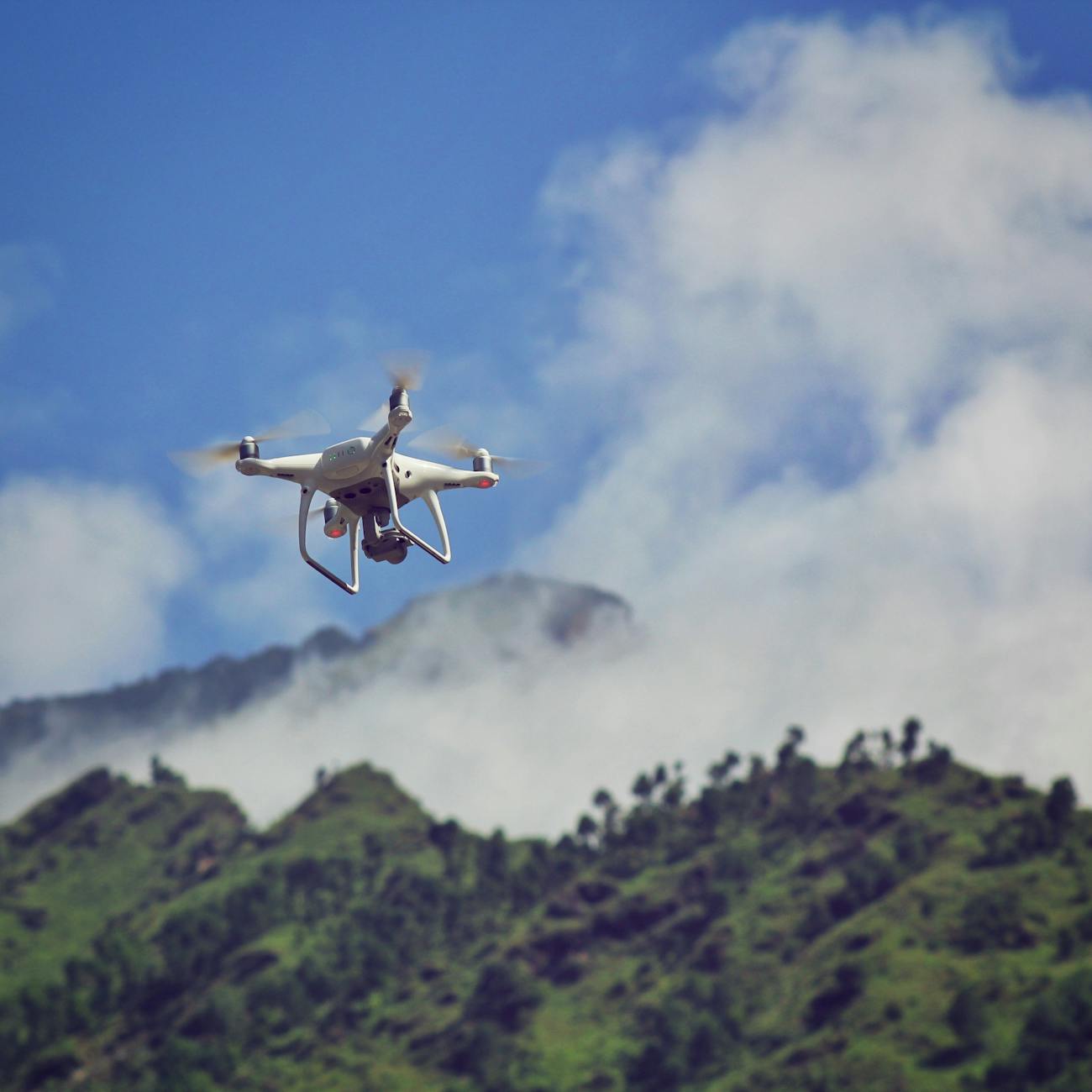
Artificial Intelligence (AI) is a branch of computer science that aims to create machines that mimic human intelligence. AI-Powered Drone Technology is an application of AI in drones to enable them to perform tasks autonomously and intelligently. Here are some key terms and vocabulary related to the Fundamentals of Artificial Intelligence in the course Professional Certificate in AI-Powered Drone Technology.
1. Machine Learning (ML): Machine Learning is a subset of AI that enables machines to learn from data without explicit programming. ML algorithms can be categorized into supervised, unsupervised, and reinforcement learning. Supervised learning involves training a model on labeled data, unsupervised learning involves training a model on unlabeled data, and reinforcement learning involves training a model through trial and error. 2. Deep Learning (DL): Deep Learning is a subset of ML that uses neural networks with many layers to learn complex patterns in data. DL models can learn features automatically from raw data and achieve state-of-the-art performance in many tasks, such as image recognition and natural language processing. 3. Neural Networks (NN): Neural Networks are computational models inspired by the structure and function of the human brain. NNs consist of interconnected nodes or neurons that process information in parallel. NNs can learn patterns in data through backpropagation, a method of adjusting the weights of the connections between nodes to minimize the error of the output. 4. Computer Vision: Computer Vision is a field of AI that deals with enabling machines to interpret and understand visual information from the world. Computer Vision algorithms can detect, recognize, and track objects in images and videos, enabling drones to navigate and perform tasks autonomously. 5. Object Detection: Object Detection is a task in Computer Vision that involves locating and classifying objects in images or videos. Object detection algorithms can identify multiple objects in a single image or video frame, enabling drones to avoid obstacles, track targets, and perform inspections. 6. Convolutional Neural Networks (CNN): Convolutional Neural Networks are a type of deep learning model commonly used for image recognition tasks. CNNs use convolutional layers to extract features from images and pooling layers to reduce the spatial dimensions of the feature maps. CNNs can achieve high accuracy in object detection, segmentation, and classification tasks. 7. Natural Language Processing (NLP): Natural Language Processing is a field of AI that deals with enabling machines to interpret and generate human language. NLP algorithms can analyze text data, extract meaning, and generate responses, enabling drones to communicate with humans and understand spoken commands. 8. Speech Recognition: Speech Recognition is a task in NLP that involves converting spoken language into written text. Speech recognition algorithms can transcribe speech accurately, enabling drones to understand spoken commands and interact with humans. 9. Reinforcement Learning (RL): Reinforcement Learning is a subset of ML that involves training a model to make decisions in an environment to maximize a reward signal. RL algorithms can learn optimal policies for tasks, such as navigation, path planning, and decision-making, enabling drones to perform tasks autonomously. 10. Markov Decision Processes (MDP): Markov Decision Processes are mathematical models used in RL to represent decision-making problems. MDPs consist of states, actions, and transitions, and a reward function that provides feedback to the agent. MDPs can model sequential decision-making problems, enabling drones to plan paths and make decisions based on the current state of the environment. 11. SLAM (Simultaneous Localization and Mapping): SLAM is a technique used in robotics and drone technology to enable autonomous navigation. SLAM algorithms can estimate the position and orientation of a drone while building a map of the environment in real-time. SLAM algorithms can use sensors, such as cameras, lidar, and IMU, to perceive the environment and estimate the state of the drone. 12. Path Planning: Path Planning is a task in robotics and drone technology that involves finding the optimal path for a drone to reach a destination. Path planning algorithms can consider constraints, such as obstacles, terrain, and weather conditions, to find the safest and most efficient path for the drone. 13. Autonomous Navigation: Autonomous Navigation is the ability of a drone to navigate and perform tasks without human intervention. Autonomous navigation involves a combination of sensors, algorithms, and decision-making systems that enable the drone to perceive the environment, make decisions, and execute tasks. 14. Swarm Intelligence: Swarm Intelligence is a field of AI that deals with enabling groups of agents or drones to work together to perform tasks. Swarm Intelligence algorithms can enable drones to coordinate, communicate, and cooperate to achieve a common goal, such as search and rescue, surveillance, and delivery. 15. Fuzzy Logic: Fuzzy Logic is a mathematical approach to dealing with uncertainty and vagueness in decision-making. Fuzzy Logic algorithms can handle ambiguous and imprecise information, enabling drones to make decisions based on approximate reasoning.
These are some of the key terms and vocabulary related to the Fundamentals of Artificial Intelligence in the course Professional Certificate in AI-Powered Drone Technology. Understanding these concepts is essential for designing, implementing, and operating AI-powered drones. Here are some practical applications and challenges of AI-powered drone technology.
Practical Applications:
* Aerial photography and videography * Surveillance and monitoring * Search and rescue missions * Delivery and transportation * Agriculture and crop monitoring * Environmental monitoring and conservation * Inspection and maintenance of infrastructure * Disaster response and recovery
Challenges:
* Regulation and legal issues * Safety and reliability * Privacy and ethical concerns * Battery life and endurance * Communication and connectivity * Environmental impact and sustainability * Cybersecurity and hacking
In summary, AI-powered drone technology is a rapidly growing field that requires a solid understanding of AI concepts and techniques. Mastering the Fundamentals of Artificial Intelligence in the course Professional Certificate in AI-Powered Drone Technology can enable professionals to design, implement, and operate intelligent drones that can perform tasks autonomously and intelligently. Understanding the key terms and vocabulary, practical applications, and challenges of AI-powered drone technology is essential for success in this exciting and dynamic field.
Key takeaways
- Here are some key terms and vocabulary related to the Fundamentals of Artificial Intelligence in the course Professional Certificate in AI-Powered Drone Technology.
- Supervised learning involves training a model on labeled data, unsupervised learning involves training a model on unlabeled data, and reinforcement learning involves training a model through trial and error.
- These are some of the key terms and vocabulary related to the Fundamentals of Artificial Intelligence in the course Professional Certificate in AI-Powered Drone Technology.
- Understanding the key terms and vocabulary, practical applications, and challenges of AI-powered drone technology is essential for success in this exciting and dynamic field.